
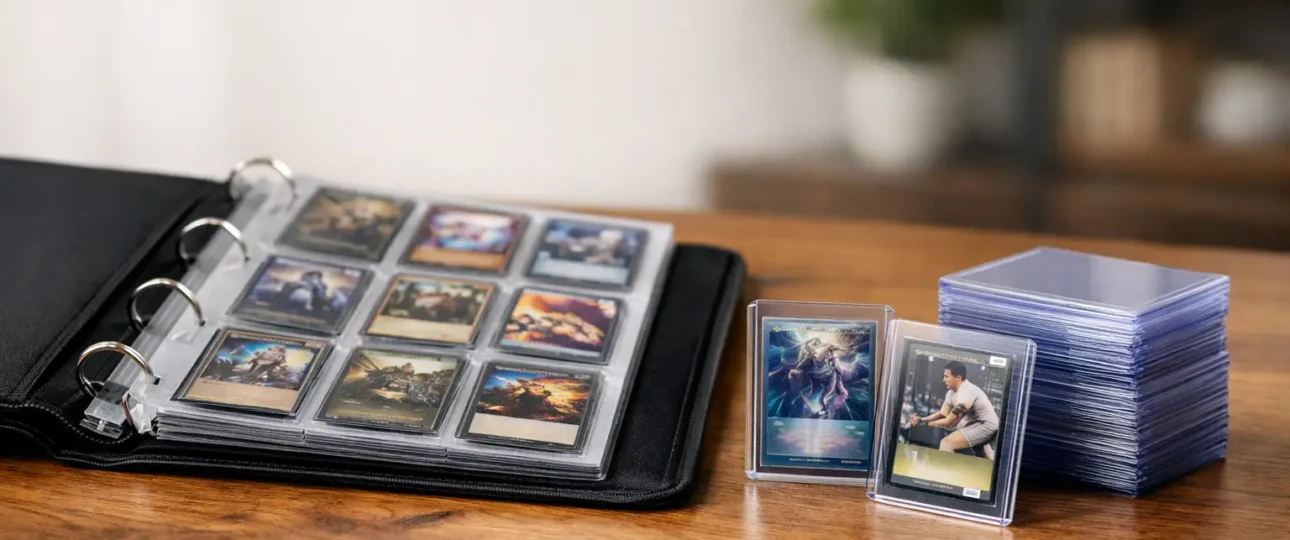
A card you are proud to pull should not disappear into a loose pile on a shelf. The real choice between a binder or toploader for card storage comes down to how you collect, what each card is worth to you, and whether you want to enjoy the collection daily or lock it down for the long haul.
For most collectors, this is not an either-or decision. A quality binder handles the collection you want organised, visible and ready to show. Toploaders take care of the smaller group of cards where maximum individual protection matters more than page-by-page presentation. Knowing where that line sits saves money, space and unnecessary handling.
Binder or Toploader for Card Storage: the quick answer
Use a binder for set building, trading cards you regularly browse, tournament decks, favourites and collections that benefit from clear organisation. A well-made binder keeps cards in order, protects them from dust and light handling, and makes checking gaps in a Pokémon set or admiring a completed Yu-Gi-Oh! page genuinely satisfying.
Use a toploader for high-value singles, graded-card candidates, rare inserts, autograph cards and anything you would be upset to see bent or pressed. A toploader is a rigid plastic case that gives a card far more resistance against knocks than a binder pocket can provide.
The strongest collection set-up is usually simple: sleeve every card you care about, store your best singles in toploaders, and place the rest of the collection in a secure binder. It gives each card the level of protection it actually needs.
Why binders remain the collector’s workhorse
A binder turns stacks of cards into a collection. That difference matters. Instead of pulling cards from a box and handling them one at a time, you can view full pages at a glance, sort by set number, type, player, rarity or colour, and spot exactly what is missing.
For Pokémon collectors, a 9-pocket layout is a natural fit for seeing an entire binder page as a clean display. It is ideal for master sets, duplicate organisation and larger collections. A 4-pocket binder is more compact and easier for younger collectors to carry, while also giving prized cards more room on the page.
Protection depends heavily on the binder’s construction. Look for crystal-clear, top-loading pockets so cards are less likely to slide out when the binder is turned or carried. A zip closure helps keep dust, accidental spills and loose cards away from the pages. Water-resistant PU leather covers add another useful layer between your collection and everyday mishaps, while a firm outer cover reduces the chance of pages being crushed in a bag.
Capacity matters too. A 400-card binder works well for a focused set, a favourite deck collection or a growing hobby. A 900-card binder makes more sense when you are sorting a large Pokémon run, multiple sports seasons or years of TCG pulls. Do not choose the biggest option automatically, though. An overfilled binder becomes heavy, harder to browse and more awkward to transport.
Binder risks worth taking seriously
Not every binder deserves valuable cards. Cheap ring binders, loose pages and poorly sized pockets can cause trouble. Cards can catch near exposed rings, pages can shift, and overly tight pockets may put pressure on corners.
If you choose a D-ring design, turn pages from the edge rather than pulling hard near the rings. Keep the binder on a flat surface while filling it, and avoid packing every pocket so tightly that pages bow. For double-sided pages, use sleeves on cards that are particularly important to you. The sleeve adds a barrier against surface scuffs and helps the card slide into the pocket cleanly.
Storage conditions still matter. Keep binders upright or flat in a dry, temperature-stable room, away from direct sunlight. A premium binder protects against normal handling and travel, but no storage product can fully protect cards left in a damp loft, hot conservatory or cluttered car boot.
When a toploader is the better call
Toploaders are made for individual protection. Once a sleeved card is inside a properly fitting toploader, it has a much stronger defence against bending, corner damage and pressure from other cards. That is why they are the standard choice for cards with serious monetary value or personal significance.
A toploader is especially sensible for a chase card you may sell, trade or send for grading. The rigid shell keeps the card safer while it is moved between storage, a trade night or a post office. For sports cards, that can mean protecting a low-numbered parallel or signed rookie. For TCG collectors, it might be a special illustration rare, vintage holofoil or tournament prize card.
Always sleeve the card first. Placing a raw card directly into a toploader can lead to surface scratching, particularly when removing it later. A soft penny sleeve is the usual starting point, provided it fits the card comfortably. Avoid forcing cards into tight holders or stacking them bare inside a box.
Toploaders have limits, however. They are bulkier than binder pages, less enjoyable for browsing and surprisingly inefficient for large collections. A hundred toploaded cards takes up real space, adds weight and needs a separate storage box to stay organised. They also do not solve every risk: a loose toploader can collect dust, and a badly stored stack can still suffer pressure or warping.
Keep toploaders organised, not just protected
A box designed for rigid holders is the practical answer. Store toploaders upright, with enough support that they do not lean heavily or slide around. Label dividers by set, player, year or card type so the collection remains searchable.
For your biggest cards, consider adding a small note outside the holder or maintaining a collection list. The point is not to overcomplicate the hobby. It is to avoid repeatedly pulling out and handling a card just to check what you own.
Choose by card value and how you use the collection
There is no fixed cash value where every card must go into a toploader. A card worth £10 might be a binder card for one collector and a protected centrepiece for another. Sentimental value, rarity, condition and how often you carry the card all count.
Think about three practical questions. First, do you want to view the card often? If yes, a binder offers the better experience. Second, would a bent corner or surface mark be a major loss? If yes, sleeve and topload it. Third, are you transporting it to events, trades or sales? Rigid protection becomes more valuable the moment a card leaves the house.
For active players, a binder can also be a useful trade folder, but only take the cards you are comfortable bringing along. Keep your premium singles at home or in toploaders inside a protective case. Tournament halls, crowded tables and hurried bag packing are not the place for a grail card in a basic page.
Build a storage system that grows with you
The cleanest system separates cards by purpose. Use one binder for a set you are completing, another for trades or duplicates, and toploaders for the cards that need individual protection. This makes your collection easier to enjoy and removes the pressure to treat every common card like a museum piece.
Binder Beast binders are built for this middle ground: sleek protection for serious collectors who want their cards secure, organised and ready to display. Features such as top-loading pockets, secure closures and travel-friendly covers are not just cosmetic upgrades. They reduce the everyday risks that build up through browsing, carrying and storing a collection over time.
Whatever you choose, keep one rule at the centre of your set-up: protect cards according to how much they matter to you, then make them easy to find. A collection that stays hidden because it is impossible to organise is not getting the attention it deserves.