
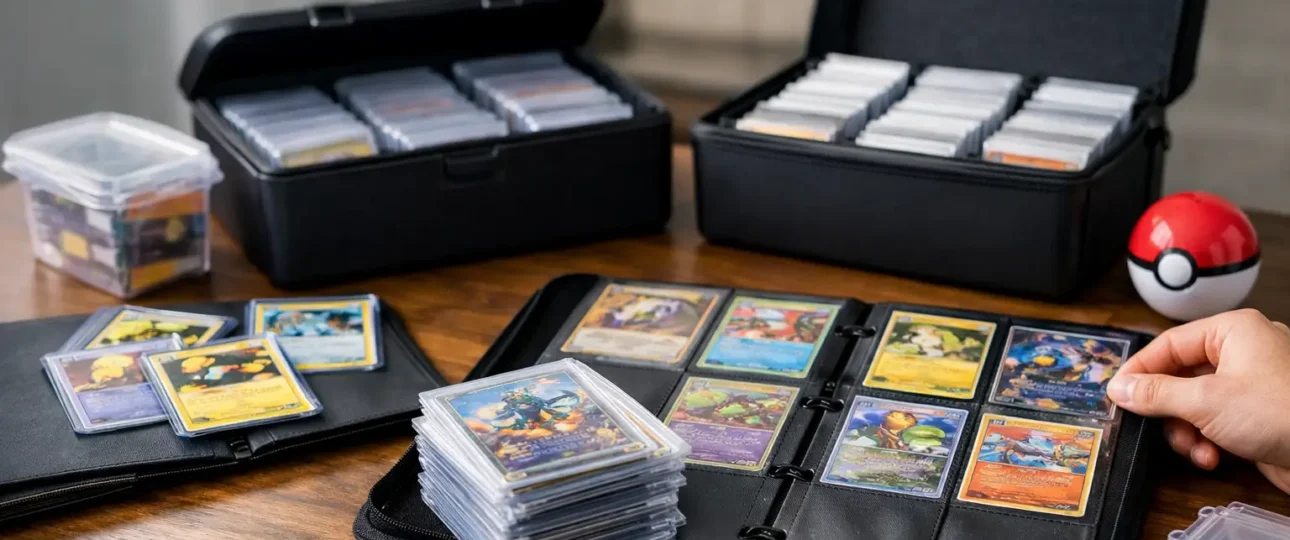
A rare pull should not end up loose in a drawer, rubbing against bulk cards or catching a bent corner every time you look for it. This Pokémon card storage guide is built for collectors who want their cards protected, easy to find and ready to show off – whether you are filling your first binder or managing years of hits, holos and favourite sets.
The best setup is not always the most expensive one. It is the one that matches how you collect. A child building a Pokédex, a player carrying a deck to league night and a collector preserving valuable singles all need slightly different protection. Start by separating cards according to their role, then choose storage that gives each group the right level of care.
Start by sorting before you store
Do not buy storage first and hope everything fits later. Gather your cards, clear a clean table and make a few simple piles: cards for display, cards for playing, cards for trading, duplicate cards and cards you may want to sell. This first pass makes the rest of your storage decisions far easier.
For set collectors, organising by expansion and card number is usually the cleanest route. If you collect favourite Pokémon rather than complete sets, organise by character, type or rarity instead. There is no wrong system if you can find a card quickly and stick to it.
Keep valuable cards separate from everyday bulk. A full-art card, a vintage holo or a card with grading potential deserves more protection than a stack of common duplicates. Mixing everything together may save space, but it increases handling and makes accidental damage much more likely.
Sleeves are the first line of protection
A sleeve protects the card surface from fingerprints, light scuffs and the tiny scratches that appear during repeated handling. For cards you play with, use a consistent set of quality sleeves so your deck shuffles cleanly and no card is identifiable from the back.
For collectible singles, a soft inner sleeve can add an extra barrier before the card goes into a binder pocket or rigid holder. Make sure the card slides in without force. If a sleeve is too tight, pushing a card into it can catch an edge or damage a corner.
Sleeves are useful, but they are not a complete storage solution. They will not stop bends, crushing pressure or moisture. Think of them as the card’s clothing, while your binder, box or case is the protection around it.
Choose a binder for cards worth viewing
A binder is the best home for cards you want to enjoy regularly. It keeps a collection organised, turns pages into a display and limits the need to handle individual cards. For Pokémon collectors, that matters: completing a page of illustration rares or seeing an evolution line together is part of the fun.
Look for top-loading pockets, which reduce the chance of cards slipping out when the binder is carried or stored upright. Crystal-clear pages let the artwork show properly, while a secure zip or elastic closure helps keep dust, loose cards and page movement under control.
Pocket count should match the way you collect. A 4-pocket binder is compact, easy for younger collectors to carry and ideal for smaller collections, trade cards or prized pulls. A 9-pocket binder gives you a classic full-page layout and more capacity for set building. If your collection is growing fast, buying a little more room than you need today prevents a frustrating reshuffle in a few months.
Fixed-page binders are straightforward and travel well because there are no loose pages to manage. D-ring binders offer flexibility, letting you add, remove or rearrange pages as a set grows. The trade-off is that ring binders need careful handling. Never overfill them, and make sure pages sit flat rather than pressing against the rings.
A premium cover is more than a cosmetic upgrade. Water-resistant PU leather, reinforced edges and a structured shape help protect cards from everyday knocks while giving your collection a cleaner, more serious presentation. Binder Beast binders are designed around that balance: practical capacity, secure storage and a display-worthy finish.
Use boxes for bulk, decks and long-term overflow
Not every card needs a binder page. Storage boxes are the sensible answer for bulk, duplicate rares, deck cores and cards waiting to be sorted. Choose a box made for standard-size trading cards, and avoid cramming it full. Cards need enough room to be removed without pinching corners, but not so much empty space that stacks slide around.
Dividers make a box useful rather than chaotic. Label sections by set, type, rarity or trade status. For a large collection, a simple inventory note can save you from opening five boxes to find one Trainer card.
Deck boxes are for active decks, not permanent bulk storage. They protect a sleeved deck during travelling and keep sideboard or damage-counter space separate where needed. If you attend events, carry your deck box inside a bag rather than leaving it loose with drinks, keys or sharp accessories.
For your highest-value cards, consider a rigid card holder after sleeving. This is a better option than a binder for cards you rarely handle, plan to submit for grading or want to keep away from page pressure. It depends on your goal: binders are made for viewing a collection, while rigid holders prioritise individual protection.
Keep moisture, heat and sunlight out of the picture
Most collection damage does not come from one dramatic accident. It comes from poor conditions over time. Damp can warp cards and encourage mould. Heat can affect foils and cause pages to distort. Direct sunlight fades colour, especially when a binder is left open near a window.
Store cards in a dry room with stable temperatures, raised away from floors where possible. A loft, garage, shed or damp cellar can be risky unless it is properly climate controlled. Keep binders and boxes away from radiators, windows and places where drinks are regularly set down.
Water-resistant covers offer valuable protection against small spills and damp hands, but they are not permission to leave cards in a wet environment. If a binder gets soaked, remove it from the source immediately, open it carefully and allow airflow around the pages. Do not use high heat to dry cards, as it can make the problem worse.
Build a storage routine that protects the collection
The strongest storage system is one you maintain. Put cards away after opening packs instead of leaving them in piles. Handle cards by the edges with clean, dry hands. Before adding a card to a binder, check that the pocket is empty and that the page is not bent.
Every few months, flip through your binders and inspect boxes for dust, page stress or overcrowding. This is also a good time to move cards as your priorities change. A card that was once a binder favourite may become a trade piece, while a new chase card may deserve a sleeve and rigid holder.
Avoid stacking heavy objects on top of binders. Even a well-made binder can develop page pressure if it is stored beneath books, consoles or packed boxes. Store binders flat when possible, or upright like books with enough support to stop them leaning.
A Pokémon card storage guide for growing collections
As your collection expands, do not rely on memory alone. Give every storage format a job. Use a display binder for favourites and set pages, a compact binder for trades or travel, deck boxes for cards in use and labelled boxes for duplicates and bulk. This keeps the cards you care about most accessible without turning every storage session into a hunt.
The goal is not to seal your collection away forever. It is to give every card a safe place between the moments you enjoy it. When your storage is organised, secure and built for the way you collect, opening a binder feels less like searching through clutter and more like seeing your collection at its best.