
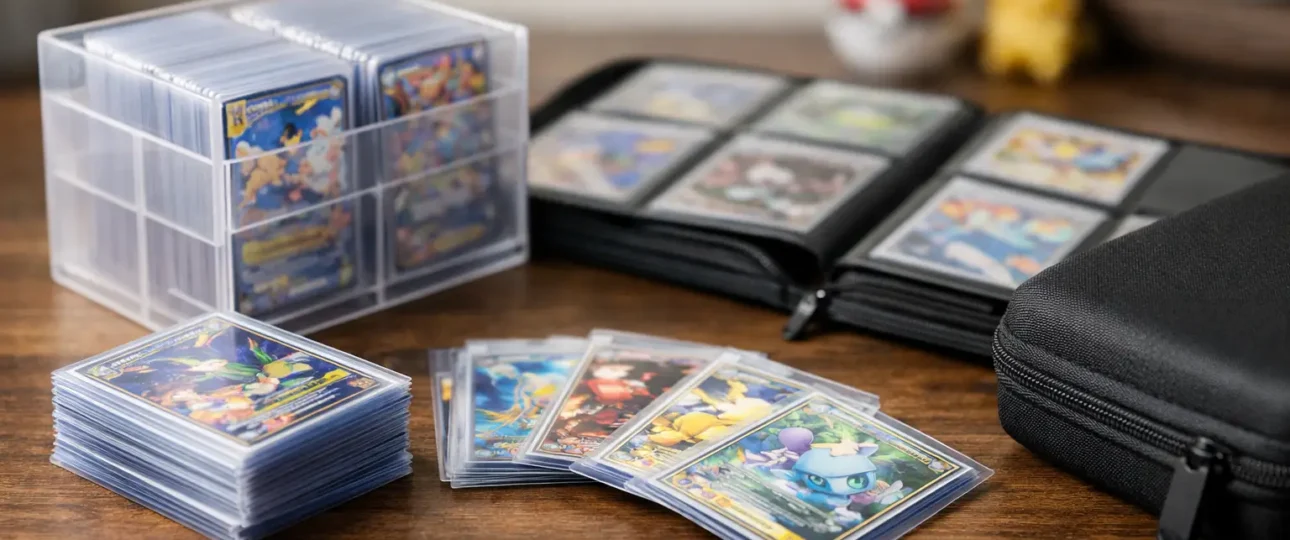
A fresh sleeve is only the first layer of protection. If the card is squeezed into an overfilled binder, left under a stack of tins, or stored somewhere damp, that clean sleeve will not prevent bent corners, warping, or surface marks. Knowing how to store sleeved Pokémon cards properly protects both the condition of the card and the work you have put into building the collection.
The best setup depends on what you collect. A childhood binder, a tournament deck, a set you are completing, and a handful of high-value pulls should not all be stored in exactly the same way. The goal is simple: keep cards supported, dry, easy to find, and safe to handle.
Start with the right sleeve setup
For most modern Pokémon cards, a standard-size penny sleeve is the starting point. It creates a barrier against fingerprints, light scuffs, and dust without adding much bulk. Make sure the card slides in smoothly. Forcing it into a sleeve can catch a corner and cause the very damage you are trying to avoid.
For cards you value more highly, use a two-layer approach. Place the card in a snug-fitting inner sleeve first, then put it into a standard outer sleeve. This reduces movement inside the sleeve and offers better edge coverage. The trade-off is thickness: double-sleeved cards take up more room, so a binder or storage box must have enough capacity and pocket depth to accommodate them without pressure.
Avoid storing cards loose in rigid holders unless they are also sleeved. Hard plastic can protect against bends, but a card moving against an unprotected surface can still pick up scratches. Never use rubber bands, paper clips, or adhesive labels directly on cards or sleeves.
How to store sleeved Pokémon cards in a binder
A quality trading card binder is the best everyday option for cards you want to browse, display, and keep organised. It gives each card a defined space, keeps sets visible, and makes it far less likely that cards will be piled, lost, or bent during a search.
Choose a binder made for trading cards rather than a standard office ring binder. Ordinary ring binders can cause pages to catch or bend near the rings, especially when they are full. They also tend to leave cards exposed at the top and sides. For valuable collections, fixed-page binders with side-loading pockets are a strong choice because cards are less likely to slide out when the binder is carried or turned upside down.
Top-loading pockets can also work well when they are deep, crystal-clear, and paired with a secure closure. The key is a snug fit that does not crush the sleeve. If you can see cards bowing, pocket seams stretching, or pages pulling at the spine, the binder is overfilled.
Do not overpack pockets or pages
One card per pocket is the safest default. Although some collectors place a second card behind the first to save space, this creates friction and makes both cards harder to remove. It also puts extra pressure on the pocket seam and can leave the rear card unseen for years.
Leave a little room in the binder instead of filling every pocket to its absolute limit. A 400-card binder is ideal for a focused collection or a single set, while a larger 900-card format suits bigger collections that still need a clean, display-ready layout. If your cards are double-sleeved, treat the advertised capacity as a maximum rather than a target.
Store binders upright with full support
Keep card binders upright on a shelf, like books, but do not pack them so tightly that removing one becomes a struggle. A binder that leans for months can put uneven weight on its pages and spine. Use bookends or store several binders together so they remain vertical and supported.
Do not stack heavy items on top of a binder. Even a hard cover can transmit pressure through pages, potentially causing dents, bent corners, or page impressions. A zip closure or elastic strap adds useful protection during transport, but it is not a licence to overstuff the binder.
Use card boxes for bulk storage
Binders are brilliant for cards you enjoy looking through. Storage boxes are more practical for bulk duplicates, deck-building stock, energy cards, and cards waiting to be sorted. The best box is rigid, clean, appropriately sized, and stored where it cannot be crushed or knocked over.
Keep sleeved cards standing upright in rows, with enough support that they cannot slump. If a row is only half full, use card dividers or fitted filler blocks to stop cards bending sideways. Pack cards too tightly and sleeves can catch as you pull them out. Leave them too loose and they can shift, lean, and develop bends along the top edge.
Label dividers rather than the sleeves themselves. Sorting by set, type, rarity, or deck is usually more useful than sorting alphabetically, but choose a system you will maintain. The safest storage method is the one that prevents you from repeatedly digging through a loose pile to find one card.
Protect against heat, moisture, and sunlight
Sleeves protect surfaces, not the environment around them. Temperature swings and humidity are common causes of card warping, while direct sunlight can fade artwork and discolour binder covers over time.
Store your collection in a cool, dry room inside the home. Avoid lofts, garages, sheds, conservatories, and damp cellars, where conditions can change dramatically. Keep binders and boxes away from radiators, windows, exterior walls with condensation, and areas prone to spills.
A cupboard or shelf in a regularly heated room is usually a sensible choice. If you live in a particularly humid area, silica gel packets placed near, but not inside, your storage setup can help control excess moisture. Replace them as directed. Never place damp cards in a sealed box or binder, as trapped moisture can affect the cards, sleeves, and pages.
Separate high-value cards from the main collection
Your favourite illustration rare may deserve a different approach from an ordinary duplicate. For cards with serious sentimental or financial value, use a clean inner sleeve, an outer sleeve, and a rigid holder or semi-rigid holder designed for standard trading cards. Store those holders upright in a fitted storage box, away from loose cards that may press against them.
This does not mean every rare card needs a hard case. Rigid holders add bulk, can be awkward for regular viewing, and are less convenient when you are organising a binder set. Reserve them for cards you would be upset to replace, cards you may grade, or cards you transport separately for trading or selling.
Before placing any card in a rigid holder, inspect it under good light. Make sure the sleeve is clean and free from grit. A tiny piece of debris trapped between card and sleeve can leave a surface impression if pressure is applied.
Handle sleeved cards without creating new damage
Storage habits matter just as much as the product you choose. Wash and dry your hands before sorting, especially after eating. Hold cards by their edges and avoid pressing thumbs into the centre of the sleeve. When removing a card from a binder pocket, support the page with one hand and lift gently from the upper edge rather than pulling sharply on a corner.
If you take cards to a trade night or event, carry the binder in a bag where it stays flat and protected. Do not leave it in a hot car, even for a short time. Water-resistant covers, such as those used on Binder Beast binders, offer added confidence against everyday splashes, but they should not be treated as fully waterproof storage.
Check your collection from time to time
Every few months, flick through your stored cards and look for early warning signs: curling pages, sleeves that have yellowed or split, cards slipping from pockets, or a musty smell that may point to moisture. Replacing worn sleeves early is far easier than dealing with a damaged card later.
A well-stored collection should feel effortless to enjoy. Give sleeved Pokémon cards room to breathe, proper support on the shelf, and protection from rough handling, and every page will be ready when you want to show it off, trade it, or simply admire the pull that started it all.