
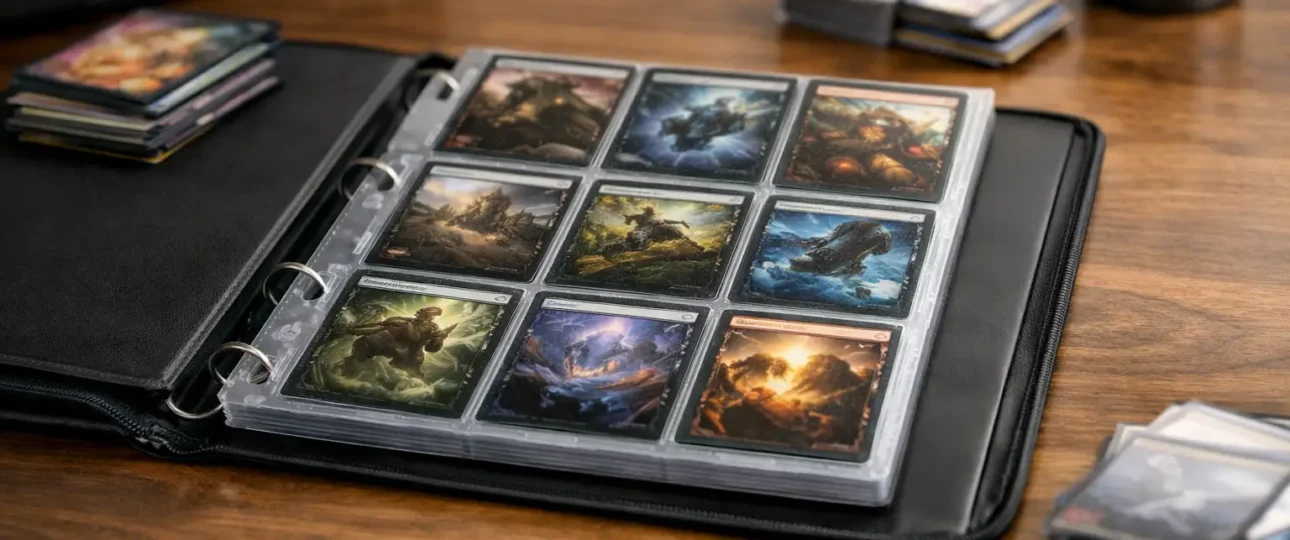
If you are sorting a growing collection and trying to avoid overstuffed pages, one question matters straight away: how many cards fit in a 9 pocket binder? The short answer is that it depends on whether each pocket holds one card or two, whether your binder has fixed pages or removable sheets, and whether you are storing cards sleeved, double-sleeved, or raw. For most standard trading card setups, a 9-pocket binder holds either 18 cards per page if you use both sides, or 9 per page if you only use one side.
That sounds simple, but real capacity is where collectors usually get caught out. A binder advertised as holding 360 cards, 540 cards, or 900 cards is not using guesswork. It is based on page count and pocket count, but the actual number of cards you should store can change depending on thickness, loading style, and how tightly you want the binder to close.
How many cards fit in a 9 pocket binder per page?
A 9-pocket page has nine card pockets on one side. If the page is double-sided, that gives you 18 pockets in total per sheet. In practical terms, that means one page stores 18 standard-size trading cards when you use both sides and place one card in each pocket.
For collectors who prefer a cleaner presentation, using only one side per page drops that to 9 cards per sheet. Some people do this for high-value cards because it reduces pressure, improves visibility, and lowers the chance of cards rubbing against each other through the page.
The maths is straightforward:
- 1 side used = 9 cards per page
- 2 sides used = 18 cards per page
So if your binder has 20 pages, the usual total is 360 cards. If it has 50 pages, the usual total is 900 cards. That is why 9-pocket binders are often sold in those capacity ranges.
How many cards fit in a 9 pocket binder overall?
The total capacity comes down to page count. Most collectors are really asking how many cards fit in a 9 pocket binder they are about to buy, not just how many fit on one page. Here is how the common capacities break down in real terms.
A 20-page 9-pocket binder usually holds 360 cards if every page is double-sided. A 30-page version holds 540 cards. A 50-page binder holds 900 cards. Those figures assume one standard card per pocket and a binder designed to support that load without strain.
That last part matters. Capacity claims are only useful if the binder is actually built for full use. A well-made binder with secure stitching, stable page backing, and a closure that does not fight against a full load will cope much better than a cheaper album that starts bowing once you get near the stated number.
What changes the real card capacity?
Not every collector stores cards the same way, so stated capacity and comfortable capacity are not always identical.
Sleeves make a difference
If you store cards in penny sleeves, most quality 9-pocket binders made for standard trading cards will still accommodate one sleeved card per pocket without much trouble. If you use thicker premium sleeves, capacity can feel tighter, especially once the binder is more than half full.
Double-sleeved cards take up more room again. Some binders can handle them, but not always at full advertised capacity. This is where collectors often need to be realistic. A binder listed at 360 cards may technically fit 360 double-sleeved cards, but if the pages bulge and the zip feels under pressure, that is not ideal long-term storage.
Top-loading vs side-loading pockets
Top-loading pockets are easy to use and popular for quick organisation. Side-loading pockets usually add more security during transport because cards are less likely to slip out if the binder moves around in a bag. Capacity is usually similar between the two, but the fit can feel slightly different depending on page material and pocket cut.
For active collectors who carry cards to locals, clubs, or events, secure pocket design matters just as much as the number printed on the product page.
Fixed-page vs D-ring binders
Fixed-page binders have a built-in page count, so capacity is set from the start. If it says 360 cards, that is what the binder is designed to hold. D-ring binders are more flexible because you can add or remove pages, but that also means you can overload them more easily.
With D-ring setups, the binder itself and the pages both affect total capacity. Add too many sheets and pages may bend near the rings, which is bad news for card corners and surface condition. For collectors who care about preservation, maxing out a ring binder is rarely the smart move.
Card type and thickness
Most 9-pocket binders are designed around standard-size cards such as Pokémon, Magic: The Gathering, sports cards, and Yu-Gi-Oh! in standard sleeves. But not every card has the same thickness. Foils, memorabilia cards, patch cards, relic cards, and toploaded cards can all change the calculation.
If your collection includes thicker inserts or premium stock, assume the practical capacity will be lower. A binder that looks perfect for a base set may not be the right fit for chunky sports hits.
Common 9-pocket binder capacities collectors actually buy
For many collectors, capacity is less about the maximum and more about the right format for the collection stage they are in.
A 360-card binder is a strong choice for set building, favourite decks, smaller Pokémon collections, or one sports team PC. It stays relatively compact, travels well, and is easier to handle on a desk.
A 540-card binder gives you more breathing room. It suits collectors who are expanding a set, separating rarity tiers, or keeping multiple categories together without needing several albums.
A 900-card binder is built for bigger jobs. It is ideal for larger archives, complete runs, or serious collectors who want everything in one place. The trade-off is weight. Once full, a 900-card binder is not as travel-friendly, especially with sleeved cards.
That is why a lot of collectors end up using more than one binder. One for active use, one for storage, and sometimes one just for top picks. It keeps pages flatter and makes the collection easier to browse.
Should you fill every pocket?
You can, but that does not always mean you should.
If your priority is pure storage efficiency, using every pocket on every page is fine as long as the binder is built for it. If your priority is premium presentation or lower pressure on valuable cards, leaving some space is often the better move. Many serious collectors avoid packing a binder to its absolute limit because a little breathing room helps pages turn more smoothly and reduces stress at the spine or zip.
There is also the question of layout. If you are displaying a master set, matching card order matters. Empty pockets may simply be placeholders for cards you have not picked up yet. That kind of organisation beats cramming in extras just to hit the maximum number.
A quick way to calculate binder capacity yourself
If the product listing does not make the total obvious, the formula is simple. Multiply the number of pages by 9 if you are using one side only, or by 18 if the pages are double-sided.
So:
- 20 pages x 18 = 360 cards
- 30 pages x 18 = 540 cards
- 50 pages x 18 = 900 cards
Then make a small adjustment based on how you store your cards. If you sleeve everything, especially with thicker sleeves, leave a margin rather than planning around the absolute maximum.
What size collection suits a 9-pocket binder best?
A 9-pocket binder is the classic choice for standard-size trading cards because it balances storage, visibility, and portability better than most formats. It gives each page enough space to look clean without turning the binder into a bulky brick too quickly.
For younger collectors, it is an easy format to understand and use. For tournament players, it is practical for trade binders and deck staples. For long-term collectors, it is one of the best display-friendly options for keeping sets organised and protected.
That is where premium build quality matters. A proper collector binder should not just hold cards. It should protect corners, keep pages stable, resist light splashes and knocks, and stay neat when carried around. That is the difference between simple storage and a binder that actually does the job properly.
Binder Beast builds 9-pocket binders for exactly that kind of use – clean presentation, secure storage, and capacity that works in the real world, not just on paper.
If you are choosing your next binder, do not just ask how many cards it can hold. Ask how well it holds them once the collection starts getting serious.