
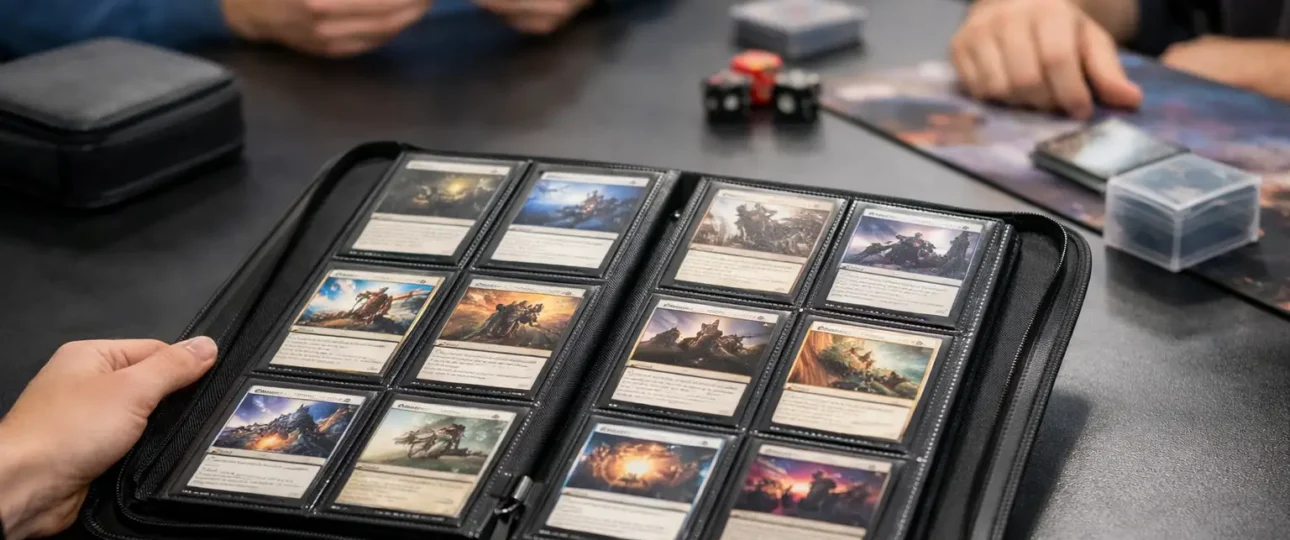
You notice a tournament binder the moment it hits the table. Not because it is flashy, but because it looks sorted, secure and ready. A good card binder for tournaments does more than carry trades – it protects value, speeds up deck checks, keeps staples easy to find and saves your cards from the usual knocks of travel, queues and crowded venues.
If you play regularly, the wrong binder becomes annoying fast. Pages sag, cards slide, the cover bends in a backpack and suddenly your best pulls are rubbing against each other on the train home. Tournament storage needs a different standard from a binder that mostly stays on a shelf.
What makes a card binder for tournaments different?
At home, display matters. At events, function matters first. Your binder is going in and out of a bag, onto busy tables and through long days where speed and protection count equally.
That means the best tournament binder usually has a tighter build, a more secure closure and pockets that hold cards firmly when the binder is moved around. It also needs to open cleanly without fighting you every round. If you are carrying trades, side deck options or spare staples, you want quick access without exposing the whole collection to wear.
There is also a simple reality serious collectors already know – tournaments are rough on gear. Drinks get knocked. Bags get stacked. Weather changes. A soft, flimsy album might be fine for casual use, but for event days it often shows its limits.
Choosing the right card binder for tournaments
The best choice depends on what you actually bring to events. Some players only need a slim binder for trades and high-value extras. Others want a larger format for full sets, side options and a wider trade folder. Bigger is not always better.
4-pocket vs 9-pocket binders
A 4-pocket binder is often the sharper option for tournament travel. It is easier to carry, faster to flip through in a crowded space and less awkward on small tables. If you mainly bring premium cards, key trades or a focused selection, a compact format feels cleaner and more controlled.
A 9-pocket binder suits players and collectors carrying more stock. It gives you better spread for organising by set, rarity, archetype or value band. The trade-off is size. A full 9-pocket binder can become heavy, and if it is overstuffed it loses some of the neat, professional feel that makes trading easier.
For many tournament players, the sweet spot is simple: use a 4-pocket binder when portability matters most, and move to a 9-pocket only if your event loadout genuinely needs the extra capacity.
Capacity matters, but so does restraint
A binder that holds 400 or even 900 cards sounds appealing until you are carrying it all day. Capacity is useful, but dead weight is not. If half the binder never gets opened at events, that bulk is working against you.
Think in terms of purpose. Are you bringing binders to trade, to store expensive pulls after buying packs, or to keep deck pieces protected between rounds? Once you know the job, the right capacity becomes much easier to judge.
The features worth paying for
Not every premium feature is marketing fluff. Some genuinely make tournament use easier and safer.
Zip closure vs elastic band
A zip closure gives stronger all-round security. If the binder drops or gets pressed in a bag, cards are far less likely to shift or edges to catch. It also adds confidence when you are moving quickly between venues or packing up in a rush.
Elastic closure binders can still work well, especially if you want quicker access and lighter weight. But the elastic needs to feel firm and durable. A loose band is not much help once the binder fills out.
If your cards are valuable or you travel to events often, zipped protection is usually worth it.
Top-loading pockets
For tournament use, top-loading pockets are a strong choice because they help prevent cards slipping out during movement. This matters more than many buyers expect. A binder might look good online, but if the pocket design feels loose when carried upright, it is not built for event life.
Crystal-clear pages also help. You do not want to angle the binder under venue lighting just to check whether a card is holo, first edition or the version your trade partner wants.
Water-resistant outer materials
This is one of those features people ignore until they need it. Travel to enough events and at some point your binder will meet rain, condensation from a bottle or a sticky tournament table.
A water-resistant PU leather cover gives you a useful layer of protection without making the binder look overly utilitarian. It keeps the binder feeling collector-grade while still being practical for the real world.
Page stability and overall construction
A tournament binder should hold its shape. Covers should feel firm, not floppy. Pages should turn smoothly, not bunch near the spine. The whole binder should look tidy when partially full and stay controlled when fully loaded.
This is where build quality starts separating premium binders from generic card albums. Better stitching, cleaner edges and stronger materials are not just aesthetic upgrades. They help the binder survive repeated use.
How to organise your binder for actual event use
A smart layout saves time and avoids unnecessary handling. The most useful tournament binders are arranged with intent, not just filled wherever space appears.
Keep your highest-value or most in-demand cards near the front, but not crowded together so tightly that browsing becomes awkward. Group similar cards in a way that makes sense to you – by game, set, rarity, archetype or trade priority. The goal is fast navigation.
Leave some breathing room. A binder packed edge to edge can feel impressive, but it is harder to browse and easier to mishandle. Empty slots are not wasted if they improve visibility and make future additions simple.
If you carry both playing staples and trade cards, separate them clearly. That avoids the awkward moment of flipping past cards you do not intend to move while someone waits across the table.
When D-ring binders make sense
D-ring binders are more divisive in tournament circles, but they still have a place. They are useful if you want page flexibility and like rearranging sections often. For larger collections or collectors who rotate inventory, that modular setup can be handy.
The trade-off is bulk and, depending on the design, a less travel-friendly profile. Ring binders can also be tougher on pages if overfilled or handled carelessly. For frequent events, many players prefer fixed-page binders because they feel slimmer, cleaner and more secure on the move.
Still, if your priority is custom organisation over compact carry, a well-built D-ring option can work.
Common mistakes buyers make
The biggest mistake is buying by capacity alone. A huge binder sounds efficient, but if it is awkward to carry and slow to use, it becomes a burden.
The second is ignoring closure quality. Tournament travel puts pressure on the edges and corners of a binder. Weak elastic, poor zip construction or a soft cover can all lead to wear faster than expected.
The third is treating any card album as suitable for serious use. Collectors with valuable Pokémon, Yu-Gi-Oh!, Magic: The Gathering or sports cards usually notice the difference quickly. Better materials, clearer pockets and stronger structure are not luxury extras when the collection inside actually matters.
What serious collectors should look for first
If you want a reliable card binder for tournaments, start with the basics that affect protection every single time you use it. Look for secure pockets, a sturdy outer shell, a closure that keeps everything contained and a format that fits your real event routine.
After that, appearance matters more than people admit. A sleek binder with a clean finish is not just about style. It presents your collection properly, makes trades feel more professional and reflects the care you put into the hobby. That is a big part of why premium storage stands out.
Brands that focus on collector-grade details, including Binder Beast, understand that a tournament binder has to do two jobs at once. It needs to protect like gear and present like a collection.
A good tournament binder should feel like one less thing to worry about. When your cards stay secure, easy to browse and ready for the next round, you can focus on playing, trading and enjoying the event instead of checking whether your storage has let you down.